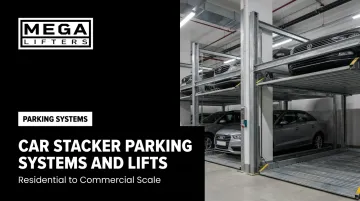
Car stacker parking systems solve this by storing multiple vehicles vertically in the footprint of a single bay. They're mechanical, relatively straightforward, and far less expensive than building new parking structures. But not all stackers are the same — the right system depends heavily on your space, your vehicles, and how the installation needs to perform long-term.
This guide covers how stacker systems work, the main configurations available, where they deliver the most value, EV charging integration, and what to evaluate before committing to a system.
Key Takeaways
- Stacker systems store 2–4 vehicles vertically in one parking bay's footprint
- Configurations range from two-post double stackers to four-level quad systems — each suited to different spaces
- Drive system choice — hydraulic or electric motor — depends on the specific application and load requirements
- EV charging can be built directly into stacking platforms; Megalifters was the first to offer this as a native feature
- Verify ceiling height, floor load capacity, and permit requirements before specifying any system
How Car Stacker Parking Systems Work
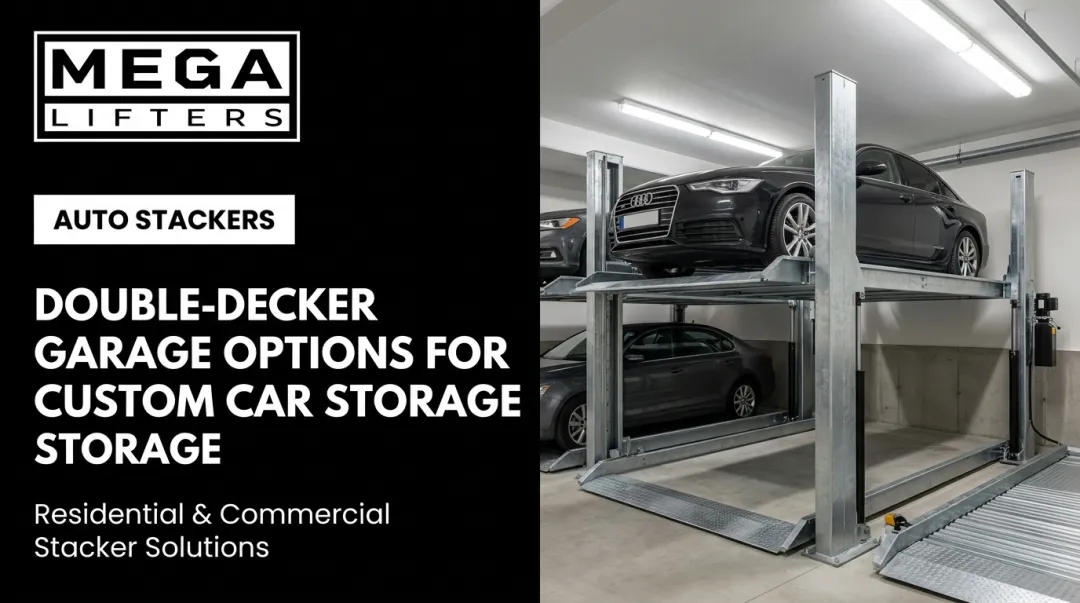
The core operating principle is straightforward. A vehicle drives onto a steel platform, and an operator activates the lift — typically via a control panel mounted on the posts — which raises the platform vertically. That frees the ground-level space for a second vehicle beneath. When the elevated car is needed, the process simply reverses.
Power Systems: Hydraulic vs. Electric Motor
Most stacker systems run on one of two drive types:
- Hydraulic drive — Pressurized fluid transmission delivers smooth operation and high load capacity. Rated platform capacities on hydraulic double stackers commonly reach 6,000 lbs, with pressure-relief valves providing overload protection.
- Electric motor drive — Runs quieter, making it well-suited for residential buildings and indoor commercial facilities where noise is a real constraint.
Many hydraulic stackers actually use an electrically powered hydraulic unit, so the two approaches aren't always mutually exclusive. Drive type selection comes down to the specific application, load requirements, and site conditions.
Structural Components and Safety
Every stacker system shares three core components:
- Primary steel structure — platforms, vertical columns or posts
- Power system — hydraulic unit or electric motor
- Control system — operator-facing panel with raise/lower controls
Standard safety features across most platforms include mechanical safety locks that engage when the platform is raised, sensor systems that halt operation if the path is obstructed, and overload protection that cuts power above rated capacity. Emergency manual lowering handles power outage scenarios.
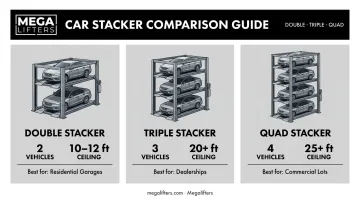
Stacker configurations range from double (2 levels) to quad (4 levels). Four levels is the highest commercially documented dependent-stacker configuration in U.S. manufacturer materials, though local code interpretation applies since no single national provision establishes this as a universal cap.
Types of Car Stacker Systems and Lifts
Two-Post Double Stackers
Two-post stackers use two vertical columns in a shared-post design. The minimal footprint and open-front configuration make it easy to drive on and off without maneuvering around obstructions.
Best for:
- Residential garages with standard ceiling heights (10–12 ft)
- Auto repair shops and small commercial lots
- Collectors and enthusiasts needing one additional storage slot
This is the most common stacker type in the U.S. and the most accessible entry point for anyone adding capacity to a single bay.
Three-Level and Four-Level (Triple and Quad) Stackers
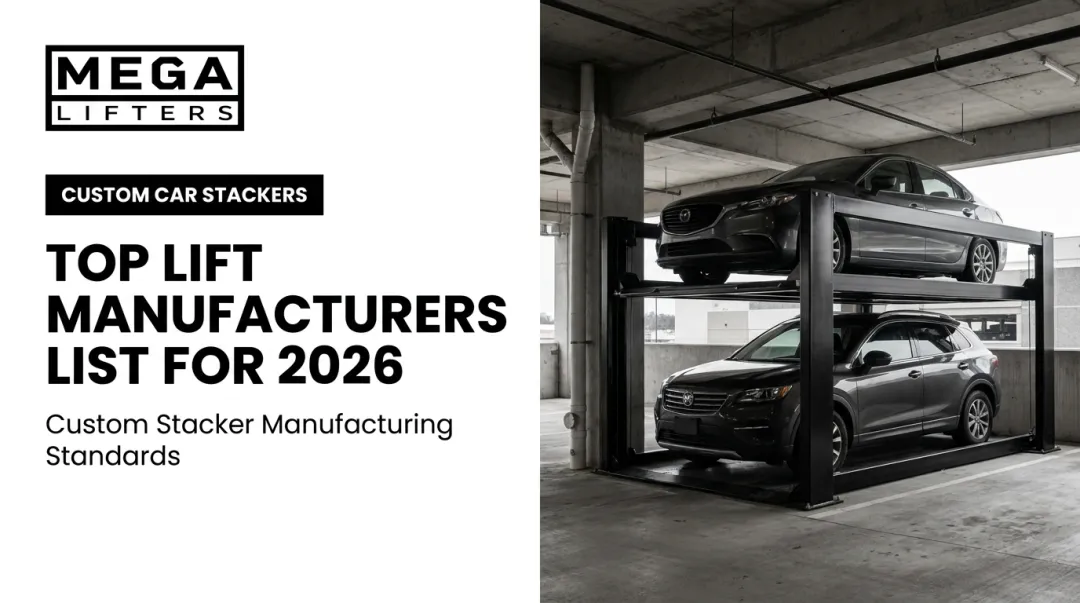
Triple and quad stackers use nested-platform systems that store vehicles at multiple elevations simultaneously — one at grade and two or three above. Four-post configurations are standard at these heights, providing the structural stability and load ratings that multi-level stacking requires.
Megalifters' Triple Car Lift requires a minimum of 20+ feet of ceiling clearance and can accommodate four vehicles total (three elevated plus one at ground level) within a single bay footprint. The Quad Car Lift steps up to a 25+ ft minimum clearance for four stacked levels.
Typical applications: dealerships managing inventory density, attended commercial parking facilities, urban developments where underground parking construction runs $50,000–$100,000 per space in high-cost cities like New York and Los Angeles.
Pit / Inground Parking Systems
Inground systems lower one vehicle below grade into a pre-excavated pit while the other sits at street level. The key distinction: each vehicle is accessible independently — you don't need to move one to reach the other.
This makes them popular for luxury residential applications and private garages where convenience matters more than density. The tradeoff is installation complexity — pit excavation makes these best suited to new construction or significant renovation projects. Megalifters' lineup focuses on above-grade vertical stacking, so buyers specifically seeking inground systems should verify this with providers during the scoping phase.
Suspended Platform Systems
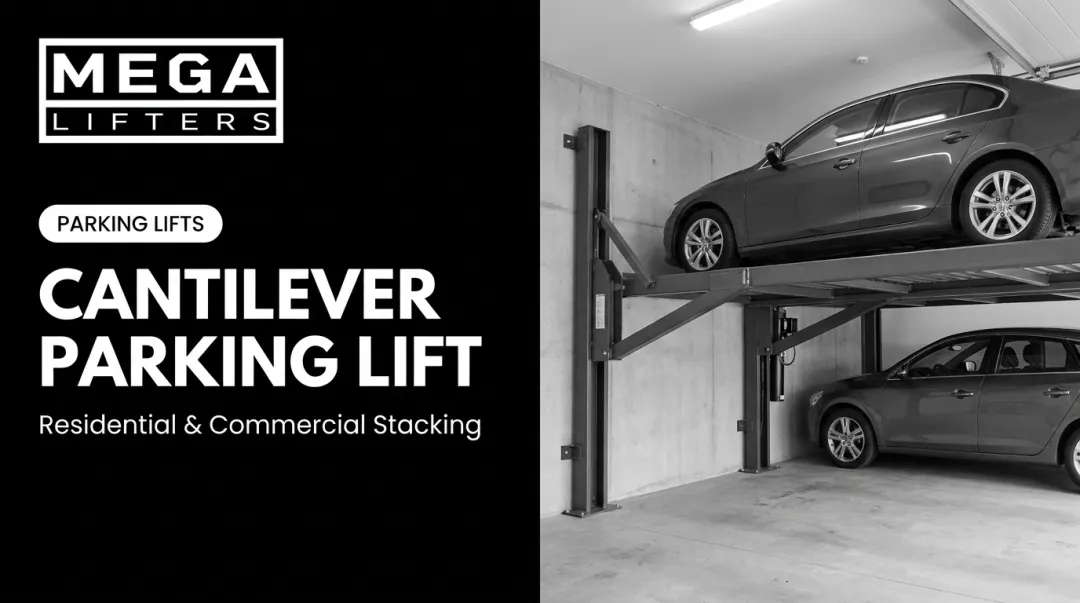
Suspended platform stackers hang from an overhead frame built into the structure rather than floor-mounted posts. Because there are no columns below the platform, the ground-level space is completely open — useful over drive aisles and in irregular spaces where post configurations won't fit. These are typically limited to two levels.
Custom and Specialty Configurations
Beyond catalog systems, specialty stackers exist for non-standard layouts: angled designs for low-ceiling environments, stack-and-slide systems for tight-entry garages, turntable stackers that rotate vehicles on an axis, and fully bespoke configurations for sites that defy standard categories.
This is where design expertise matters most. Megalifters' founder Christopher Burcham — an architectural designer by trade — started the company after hitting exactly this wall: no off-the-shelf system fit a dealership he was designing, so he engineered one himself. That background shapes how Megalifters approaches irregular-space projects: each solution is built to the site, not forced from a product sheet.
Key Benefits of Installing a Car Stacker System
Space Multiplication
A double stacker doubles parking capacity in one bay's footprint. Triple and quad systems multiply it by three or four. For dealerships and commercial operators where land cost is the primary constraint, this is the most efficient density tool available — no excavation, no structure, no extended construction timelines.
Cost Efficiency Versus Alternatives
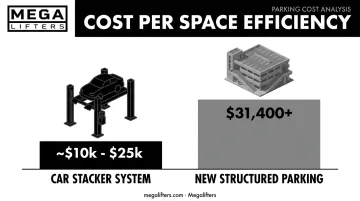
Mechanical stackers cost significantly less than semi-automated puzzle systems or fully robotic garages, and they're far cheaper than building new parking infrastructure. Structured parking construction currently averages $31,400 per space nationally — and that's before land acquisition.
At the equipment level, published retail prices break down roughly as:
- Double stackers: from ~$9,995 (BendPak PL-6000DC)
- Triple stackers: from ~$22,395
- Total project cost: equipment plus installation, permits, and site engineering
Even with those additions, the gap versus structured construction remains substantial.
On the operating cost side, maintenance is straightforward: hydraulic fluid checks, safety lock inspections, and lubrication on a scheduled basis. Harding Steel notes that well-maintained parking lifts typically last 15–20 years.
Application Versatility
Stackers work across a wide range of settings:
- Residential garages — add a second or third storage slot without expanding the building footprint
- Car dealerships — manage inventory swings and maximize display density on existing lots
- Commercial parking — meet zoning minimums without building new structures
- Automotive collectors — secure storage for high-value vehicles in a controlled environment
- Valet and attended operations — efficient vehicle retrieval at multi-level facilities
Both indoor and outdoor installations are possible. Outdoor units require weather-resistant materials and site-specific engineering review before procurement.
EV Charging Integration in Car Stacker Systems
The EV Charging Gap Parking Operators Can't Ignore
EV sales in the U.S. exceeded 10% of new car sales in 2024, and the Edison Electric Institute projects 78.5 million EVs on U.S. roads by 2035 — more than 26% of the expected fleet.
Public charging infrastructure isn't keeping pace. The U.S. had just under 200,000 public charging points in 2024, while NREL's 2030 mid-adoption scenario calls for approximately 1.2 million public ports. For parking operators and property owners, that gap has a direct implication: every space needs to be EV-capable, including stacked ones.
How Platform-Integrated Charging Works
In an EV-integrated stacker, charging hardware is built into or mounted on the stacking platform itself. When the vehicle is elevated and locked into position, it begins charging automatically — no separate step required, no unstacking just to plug in.
Megalifters positions itself as the first automobile stacker company to offer EV charging as a native platform feature rather than an afterthought. Their EV+ Charging Integration is available across all models — from a residential double stacker to a commercial quad system — in three tiers:
| Tier | Best For | Key Features |
|---|---|---|
| Basic | Residential garages, small commercial | Plug-and-play, black finish, self-pay or enterprise |
| Intermediate | Multi-family, dealerships, small fleets | Digital screen, QR code access, network-ready |
| Advanced | Fleet depots, commercial lots | Dual-unit supercharging, high-throughput |
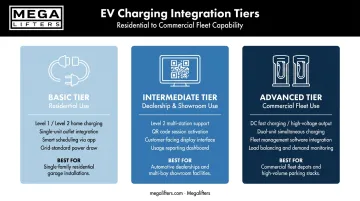
The residential-grade Basic tier is a straightforward add-on. The Intermediate and Advanced tiers introduce network connectivity, multi-user access management, and — at the Advanced level — dedicated high-capacity electrical infrastructure. Buyers should account for electrical capacity and infrastructure requirements during the planning phase regardless of which tier they're considering.
The reason it's available across every model comes down to a simple installation reality: retrofitting EV charging into an existing lift is expensive and often structurally impossible. Building it in at installation avoids that cost and complication as EV adoption grows over the next 10–15 years.
What to Consider Before Choosing a Car Stacker System
Physical Space Requirements
Ceiling height is the first variable to confirm — and it's non-negotiable.
Industry reference specs give a useful baseline for planning:
- Double stackers: BendPak's PL-6000DC has an overall height of 131 inches; clearance varies by model and vehicle dimensions
- Triple stackers: Harding's standard Tri-Lift requires a minimum of 22 ft 6 in; Megalifters' Triple requires 20+ ft
- Quad stackers: Harding's Quad-Lift requires 29 ft 6 in minimum; Megalifters' Quad requires 25+ ft
Beyond height, confirm:
- Bay footprint dimensions
- Concrete slab thickness and load capacity (requirements are model-specific; no single universal number applies)
- Vehicle dimensions — width, length, height, and weight for every vehicle being stored
Permits and Code Requirements
Local building permits are required. Requirements vary significantly:
- Vancouver, WA has a 2023 fire-department standard covering both indoor and outdoor mechanical car stackers, including design, installation, and acceptance testing
- Los Angeles requires a building permit before installation or relocation, distinguishing between dry indoor and wet outdoor models
- New York City evaluates all indoor parking stacker/platform-lift systems through the Department of Buildings' OTCR
Outdoor installations may face additional zoning review. Before signing any contract, clarify whether your installer handles permit coordination or whether that responsibility sits with you. At Megalifters, foreman Brandan Styles manages code navigation and construction site compliance directly — but confirm the scope explicitly for your project.
Custom vs. Off-the-Shelf
Standard catalog systems work well for conventional spaces. When dimensions are irregular, ceilings fall below standard model requirements, or structural constraints don't match a catalog spec, custom engineering is the only path to a system that fits and performs reliably.
Megalifters custom-designs every installation — from initial scoping through final installation — with full flexibility on size, color, capacity, and configuration. That approach delivers the most value when a space has constraints that off-the-shelf products simply can't accommodate.
Frequently Asked Questions
How does a stacker car parking system work?
A vehicle is driven onto a steel platform, which is then raised vertically by a hydraulic or electric motor system — freeing the ground-level space for another vehicle to park beneath. Platforms are secured by mechanical safety locks at the raised position, and retrieval simply reverses the process.
Which stacker car parking system is best?
It depends on the space. Two-post double stackers suit residential garages and tight commercial bays; triple and quad systems are built for dealerships and commercial facilities. Non-standard spaces — irregular dimensions, low ceilings, unusual entry angles — require custom engineering.
Can car stacker systems accommodate electric vehicles?
Yes. Standard stacker platforms can store EVs, and some systems integrate charging directly into the platform. Megalifters offers built-in EV charging across all configurations, allowing upper-deck vehicles to charge while stored without being unstacked.
Do car stacker parking systems require special permits?
Permit requirements vary by municipality. Most jurisdictions require a building permit; outdoor systems often face additional zoning review. Check local requirements before purchasing and confirm whether permit coordination is included in your installation contract.
How much does a car stacker parking system cost?
Entry-level double stackers typically start around $9,995 and triple stackers around $22,395 — equipment only, before installation, engineering, and permits. Quad and custom configurations are priced per project. Contact Megalifters at (313) 702-1023 or info@megalifters.com for a scoped quote.