Introduction
Parking space is shrinking. Land costs are rising. And whether you're a homeowner trying to fit a third car into a two-car garage or a commercial operator trying to maximize revenue from a constrained lot, the math keeps getting harder.
Building new parking isn't a realistic answer for most. According to a UCLA Institute of Transportation Studies report, the average cost to construct a single underground parking space across 17 US cities now runs $73,000 — and that's before land, permits, or financing.
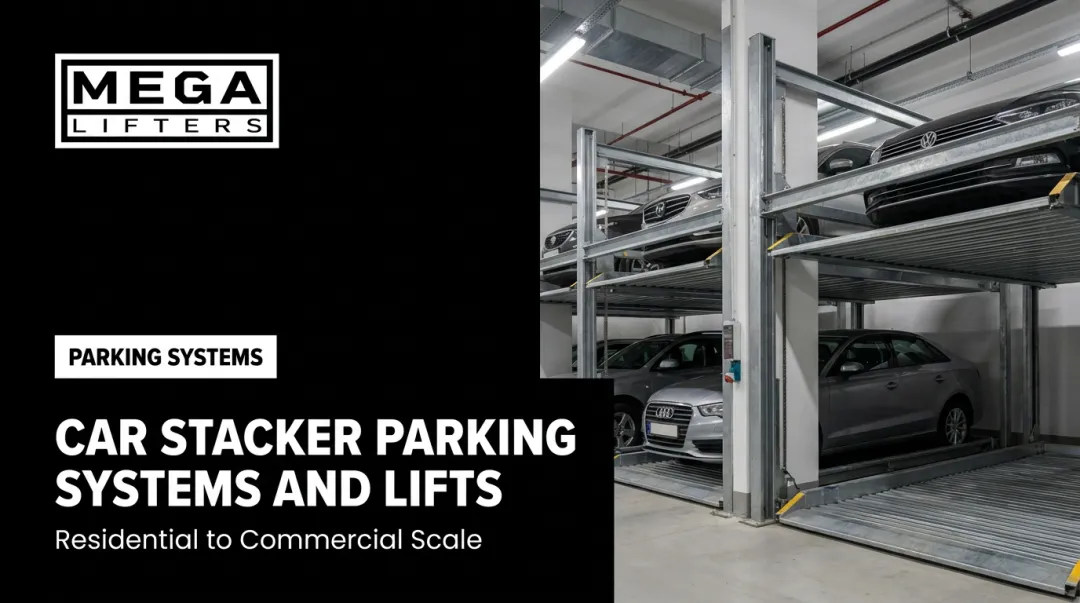
Cantilever parking lifts solve this problem without breaking ground. By stacking vehicles vertically in the same floor footprint, they double or even triple parking capacity inside an existing structure.
This article covers everything you need to make a sound decision: how cantilever lifts work, their key benefits, who uses them, what to check before buying, and how they compare to other lift types.
Key Takeaways:
- Cantilever lifts stack vehicles above existing spaces, doubling capacity without expanding the building footprint
- Open-sided platform design means no posts blocking vehicle entry or door access
- Concrete slab, ceiling height, and local permits are the three pre-installation factors that matter most
- Megalifters builds fully customizable cantilever lifts with integrated EV charging built into the platform — a first in the industry
What Is a Cantilever Parking Lift and How Does It Work?
A cantilever parking lift is a vehicle-stacking system anchored to a single column or wall-mounted structure, with an open platform extending outward on the vehicle-facing side. There are no support posts on the front or sides of the platform — the entire load transfers back to the fixed anchor point.
The Engineering Principle
The cantilever beam design works by concentrating structural support at one end. When a vehicle drives onto the platform, its weight creates a bending force (called a bending moment) that the anchored column or wall mount resists. This produces a clean, obstruction-free platform that holds a vehicle safely in the air.
Two-post or four-post lifts, by contrast, place vertical columns on multiple sides of the vehicle, requiring drivers to navigate around them when entering or exiting.
Two Main Operational Types
| Type | How It Works | Practical Notes |
|---|---|---|
| Hydraulic | Fluid pressure raises and lowers the platform smoothly | Quieter operation; requires periodic fluid maintenance |
| Electromechanical | Motor-driven chain or screw mechanism | Less fluid maintenance; slightly more mechanical noise |
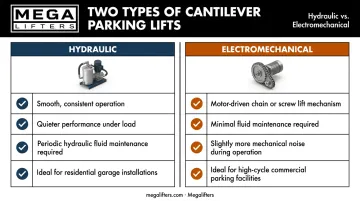
Hydraulic systems suit noise-sensitive environments like residential garages; electromechanical systems work well where fluid maintenance is a concern, such as commercial facilities with high cycle frequency.
Typical Specifications
Published product benchmarks for explicit cantilever and single-post parking systems generally fall in these ranges:
- Load capacity: approximately 4,400–6,000 lbs (2,000–2,700 kg) per platform
- Platform width: approximately 7–9 ft (2,100–2,700 mm)
- Vertical rise: approximately 5–7 ft (1,600–2,100 mm)
These are manufacturer-specific figures, not industry-wide standards — actual specs vary by model and configuration.
Key Benefits of a Cantilever Parking Lift
Space Multiplication
The most direct benefit: stacking one vehicle directly above another doubles the number of cars you can store in the same floor area. In markets where underground parking construction averages $73,000 per space — and can reach $111,000 per space in cities like Portland — a lift installation delivers a compelling return compared to new construction.
Triple-stacker configurations take this further, and automated systems can support up to seven levels in commercial deployments.
Open-Sided Accessibility
Because there are no posts on the vehicle-facing side:
- Drivers can open car doors fully without obstruction
- Mechanics can access the vehicle from all angles
- Entry and exit is faster, even in narrow bays
- The ground-level space beneath the raised vehicle remains usable
That open-sided layout is what makes cantilever designs particularly practical in narrow bays where two-post and four-post alternatives fall short.
Safety Features
Modern parking lifts include multiple layers of built-in protection. Based on manufacturer documentation and industry standards (ANSI/ALI ALCTV:2025 governs construction, testing, and validation for automotive lifts), common safety features include:
- Anti-slip or textured platform surfaces
- Mechanical locking mechanisms that engage when the platform is raised
- Overload sensors and anti-overload valves
- Emergency stop controls
- Photoelectric sensors to detect obstructions
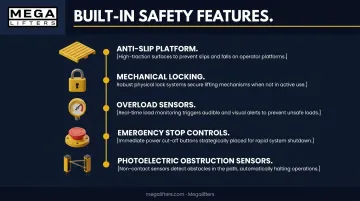
New York City's indoor stacker regulations, for reference, specifically require positive mechanical locking, keyed constant-pressure controls, and platform-level sensors — illustrating the safety rigor applied in high-density commercial environments.
Customization and EV Charging Integration
Cantilever lifts can be configured for a single residential stall or scaled across an entire commercial lot. Megalifters builds every system to order — any color, size, and weight capacity — from a compact two-car residential stacker to multi-level urban installations.
What sets Megalifters apart is EV charging built directly into the lift platform. The charger rises with the car, so an EV on the upper deck charges while stored — no need to bring it down to reach a ground-level station. Three tiers are available:
- Basic — Plug-and-play setup for residential and small commercial use
- Intermediate — Digital interface with QR code access and network connectivity
- Advanced — Dual-unit supercharging for high-throughput commercial facilities
This platform-integrated approach is not available on standard automobile stackers, making it a practical option for property owners planning EV infrastructure alongside parking expansion.
Who Uses Cantilever Parking Lifts?
Residential Homeowners and Collectors
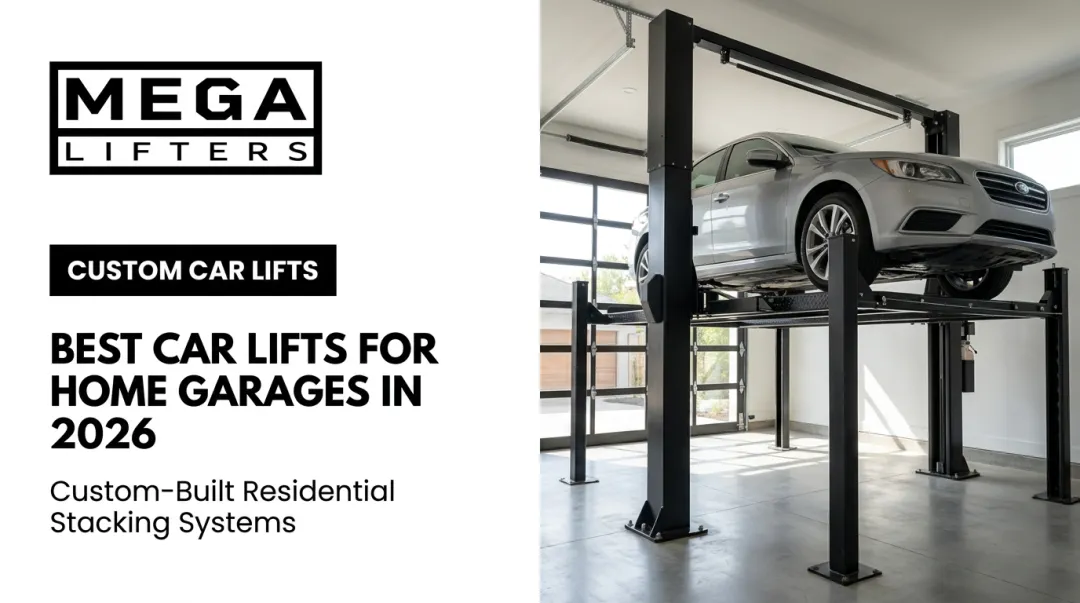
The most common residential scenario: a two-car garage that needs to hold three or four vehicles. Automotive enthusiasts and collectors are the primary buyers here, particularly those with a mix of daily drivers and vehicles they want protected and accessible.
Single-column systems designed for standard 10–12 ft ceilings handle this well. Megalifters has installed systems housing everything from classic muscle cars to exotic sports cars, including:
- Ferrari and Rolls-Royce collections in private garages
- Track-day vehicles requiring protected, accessible storage
- Multi-vehicle setups with automated controls and custom finishes
Commercial Parking Facilities and Urban Operators
Multi-bay stacking systems allow commercial operators to increase vehicle capacity within existing structures, avoiding the cost of new construction or property acquisition. In dense urban markets where land is expensive and expansion isn't viable, this is the only financially rational path to adding parking inventory.
Megalifters' systems scale from small multi-family lots to large urban deployments, with configurations that can accommodate thousands of vehicles across a city block.
Car Dealerships
Dealerships face a specific version of the space problem: more inventory needs to be visible and accessible without expanding the physical footprint of the facility. Cantilever and stacking lifts allow them to store vehicles vertically in showrooms and on lots, keeping more units ready for display or delivery.
Founder Christopher Burcham's first Megalifters installation was designed for a dealership — he built the system himself when no existing product could maximize vertical stacking in the space he was designing.
What to Consider Before Installing a Cantilever Parking Lift
Ceiling and Vertical Clearance
Available height is the first constraint to check. As a general reference from published sources, parking lifts typically require 11–15 ft of clearance for two-level configurations, depending on vehicle height and system design.
For Megalifters' lineup specifically:
- 2-Post Single Car Lift: designed for standard 10–12 ft ceilings
- Triple Car Lift: requires 20+ ft clearance
- Quad Car Lift: requires 25+ ft clearance
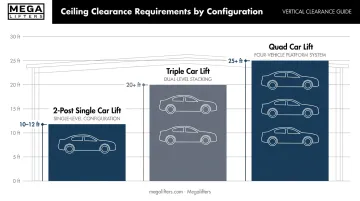
SUVs and trucks are generally not ideal candidates for vertical stacking due to their height. For those vehicles, a side-by-side horizontal configuration (like a double-wide lift) is typically the better fit.
Floor Slab Thickness and Load Capacity
The concrete slab must support the combined weight of the lift structure and all vehicles it holds. Requirements vary by model, so always reference your specific installation manual — but current BendPak specs offer a useful baseline:
Current parking-lift manuals from BendPak provide useful reference points:
- BendPak PL-6000DC/DCX (two-post parking lift): minimum 6 inches thick, 4,350 psi, steel reinforced, with a minimum 28-day cure
- BendPak HD-973P/PX (multi-level system): minimum 6.5 inches thick, 3,000 psi
The applicable model's installation manual controls the actual requirement. A structural assessment by a licensed contractor before installation is strongly recommended — Megalifters' Foreman, Brandan Styles, handles this evaluation as part of every project.
Permits and Local Building Codes
Permit requirements vary by municipality — some require full review, others nothing at all. Check with your local building department before purchasing.
New York City, for example, requires site-specific review for indoor parking stackers through its Office of Technical Certification and Research, with a $600 processing fee and compliance with Buildings Bulletin 2015-015. Other cities have their own processes.
A contractor with local code experience can shorten this process considerably and help you avoid costly surprises mid-project.
Power Supply Requirements
Every lift — hydraulic or electromechanical — requires a dedicated electrical circuit. Plan for this early, especially if you're adding EV charging. Key electrical considerations include:
- Standard lift circuits: dedicated line sized to the lift's motor specs
- Basic/Intermediate EV tiers: moderate added load, manageable with standard residential panel upgrades
- Advanced EV tier (dual commercial supercharging): substantially higher power demands that require early coordination with a licensed electrician
Bring your electrician into the scoping phase, not after the lift is ordered.
Cantilever Lifts vs. Other Parking Lift Types
| Lift Type | Floor Space Required | Vehicle Entry/Exit | Typical Use Case |
|---|---|---|---|
| Cantilever / Single-post | Minimal — one anchored column | Open-sided, unobstructed | Residential, dealership, tight bays |
| Two-post parking lift | Moderate — two side posts | Posts on both sides of vehicle | Residential and small commercial storage |
| Four-post stacker | Larger footprint — four posts | Posts at all corners | High-density multi-level storage |
| Scissor/puzzle system | Varies — semi-automated | Independent retrieval, no dependent vehicles | Large commercial and multifamily facilities |
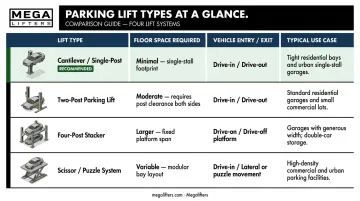
The cantilever design wins in one specific scenario: constrained horizontal space where additional posts would block access or require a wider bay. It's the right choice when the goal is storage, not under-vehicle service access.
That said, the tradeoff is installation complexity. The anchored column must be set into a structural floor anchor or wall — a load-bearing connection that requires professional assessment and proper engineering. This isn't a DIY installation.
How Megalifters Designs Custom Cantilever Parking Lifts
Megalifters builds every system from the ground up for each client's specific space. Founder Christopher Burcham — an architectural designer by trade — oversees design and project coordination from start to finish. Foreman Brandan Styles manages structural execution and code compliance on-site.
Every installation is sized to your bay, your vehicles, and your ceiling height — not a stock product retrofitted into a space it wasn't built for.
Two capabilities set Megalifters apart from standard lift suppliers:
- Any color, size, and weight capacity — from a single residential stall to multi-level commercial installations.
- EV charging built directly into the lift platform, so vehicles charge in the stored position at any level. Megalifters is the only automobile stacker manufacturer to offer this as a standard platform option.
Both capabilities are available on every project, regardless of scale. Megalifters serves residential and commercial clients across the US and Canada, with international work available on custom quote.
To discuss your project:
- Phone: (313) 702-1023
- Email: info@megalifters.com
- Address: 36253 Michigan Ave, Wayne, MI 48184
Frequently Asked Questions
What is a cantilever lift?
A cantilever parking lift is a vehicle-stacking system supported on one side by a single column or wall mount. The platform extends outward with no posts on the open side, allowing a car to be raised and stored above a ground-level parking space without blocking entry, exit, or door access.
How thick does a concrete slab need to be for a car lift?
There's no single universal minimum — it depends on the specific lift model. Current parking-lift manuals cite minimums such as 6 inches at 4,350 psi for one BendPak two-post system, and 6.5 inches at 3,000 psi for another. A structural assessment by a licensed contractor before installation is strongly recommended.
Is it legal to have a car lift in your garage?
Car lifts are legal in most US residential garages, but permit requirements vary by municipality. Some jurisdictions require a building permit and structural review; others don't. Check with your local building department or consult a licensed contractor before purchasing.
What is the weight capacity of a cantilever parking lift?
Manufacturer examples for cantilever and single-post parking systems typically range from approximately 4,400 to 6,000 lbs (2,000–2,700 kg) per platform. Match capacity to the heaviest vehicle you plan to store. Megalifters offers multiple weight capacity tiers across all models.
Can a cantilever parking lift support EV charging?
Most standard cantilever lifts don't include EV charging capability. Megalifters is the first automobile stacker manufacturer to integrate EV charging directly into the lift platform itself, so electric vehicles charge in the stored position without needing to be lowered first. This is available in Basic, Intermediate, and Advanced tiers to suit residential through commercial applications.