Introduction
Running out of garage space is a real problem for collectors and multi-car households — and the frustrating part is it often has nothing to do with the size of the property. The floor space exists. The ceiling clearance exists. What's missing is a smart vertical storage strategy.
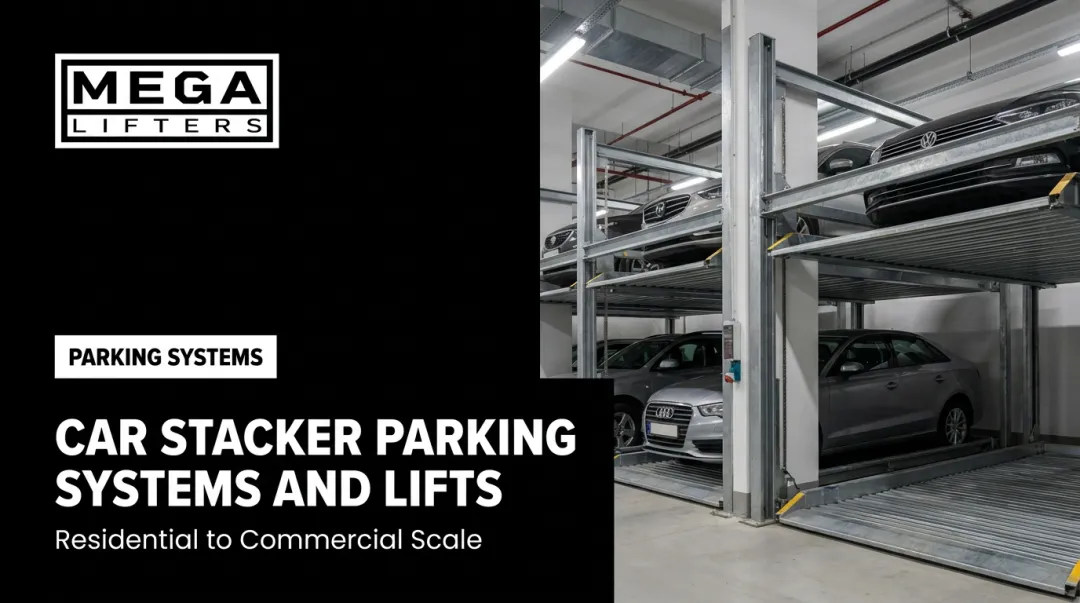
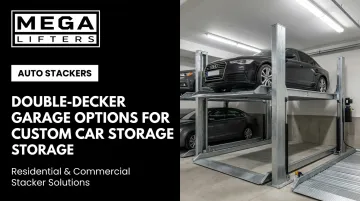
Double-decker car storage solves this by stacking vehicles on mechanical platforms within a single stall, doubling or tripling capacity without adding square footage.
Demand has followed. U.S. Census Bureau 2024 data shows 65% of newly completed single-family homes included two-car garages, and 15% included garages for three or more cars. Multi-vehicle storage is now a baseline expectation in residential design — not an upgrade.
This guide covers the main system types, five providers worth evaluating, and the specs to verify before you commit.
Key Takeaways
- Double-decker car storage stacks vehicles vertically using mechanical platforms or four-post lifts — no footprint expansion required.
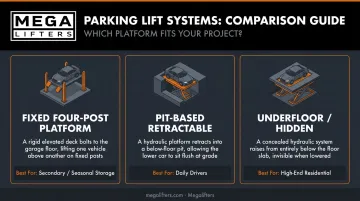
- Three system types exist: fixed-platform, pit-based retractable, and underfloor hidden — each suited to different budgets and use cases.
- Ceiling height (min. 10 ft for most residential systems), floor load capacity, and vehicle weight are the non-negotiables before purchasing.
- Custom providers like Megalifters build to any size, capacity, and color — with integrated EV charging available across all models.
- For collectors with unusual vehicles or non-standard garages, off-the-shelf lifts frequently cost more in the long run.
What Is a Double-Decker Garage? Understanding the Basics
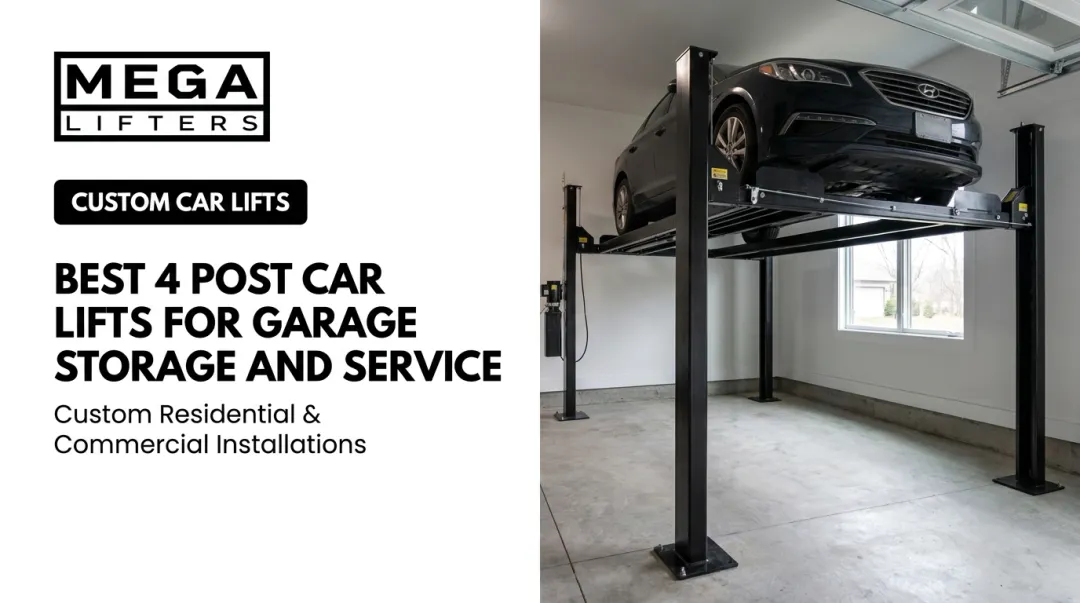
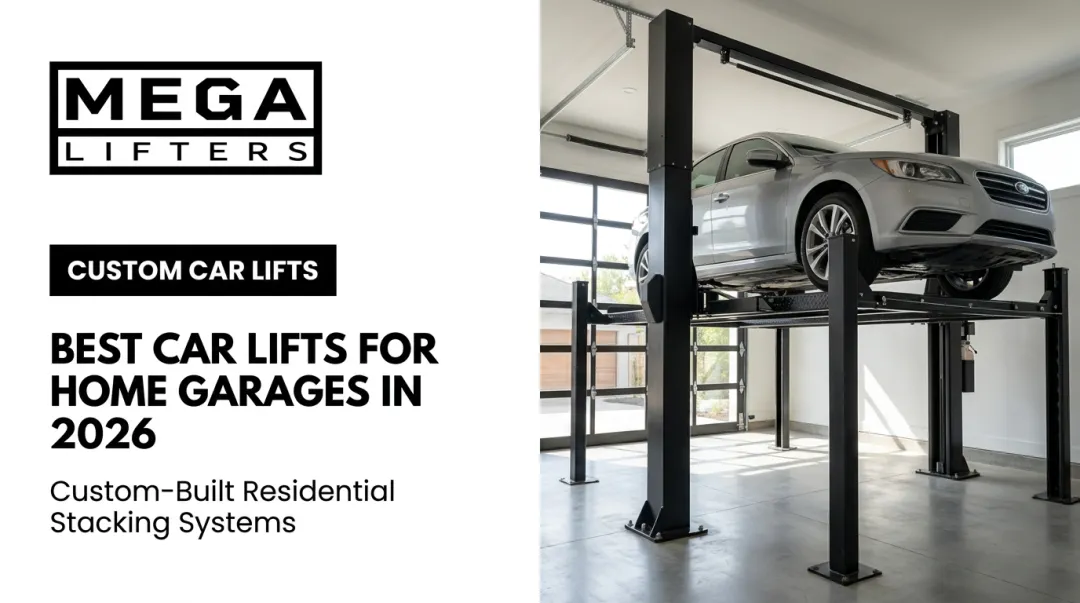
A double-decker garage is a storage configuration, not a building type. Mechanical platforms or lifts stack one vehicle above another within a single stall, effectively doubling what that floor area can hold.
Two alternatives often get confused with it:
- Tandem garage — cars park front-to-back in one elongated bay. No lifting required, but you always move the front car to access the rear one.
- Side-by-side garage — two cars in two adjacent stalls at ground level. Wide footprint, no height efficiency.
Where tandem and side-by-side layouts expand outward, double-decker systems expand upward — making them the practical choice when floor space is fixed.
The Three Main System Types
| System Type | How It Works | Best For |
|---|---|---|
| Fixed four-post platform | One car drives onto elevated runways; lower bay stays open for a second car | Most budgets; secondary/seasonal vehicle storage |
| Pit-based retractable | Both vehicles independently accessible via platform movement within a pit | Daily drivers needing frequent independent retrieval |
| Underfloor/hidden | Vehicle descends underground beneath a flush-covering platform | High-end residential; maximum concealment |
Structural Requirements
Before any system goes in, three factors need verification:
- Ceiling height — most residential four-post systems require a minimum of 10 ft of clear ceiling height; taller vehicles need more
- Floor slab — manufacturers typically require a minimum of 4–5 inches of 3,000 PSI concrete, fully cured, with no asphalt or cracked expansion seams
- Garage door clearance — ceiling-mounted openers can obstruct lift travel; wall-mounted openers from brands like Chamberlain or LiftMaster reclaim that overhead space
Top Double-Decker Garage Options for Custom Car Storage
The five providers below were selected based on customization range, safety credentials, installation support, and suitability across residential and commercial settings.
Megalifters
Megalifters is a Wayne, MI-based custom automobile stacking specialist founded by architectural designer Christopher Burcham — who started the company after finding no off-the-shelf solution could fit a vertical stacker into a dealership he was designing. So he built one himself.
That origin story still defines how Megalifters operates. Every project runs from architectural design through final installation, handled by Christopher alongside foreman Brandan Styles, who navigates code compliance and construction from start to finish.
Where Megalifters stands out most clearly is customization depth. Every lift is built to specification — any color, any size, any weight capacity. Their lineup runs from compact 2-post residential lifts for standard 10–12 ft ceilings to quad car lifts stacking four vehicles in one bay footprint (requiring 25+ ft clearance). They serve residential collectors, dealerships, and large-scale urban parking operators.
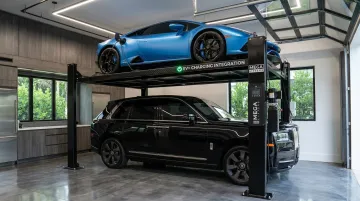
On top of that, Megalifters is the first automobile stacker to integrate EV charging directly into the platform. Their EV+ system is available in three tiers — Basic for residential, Intermediate for multi-family and dealerships, and Advanced for commercial supercharging — so an EV can charge in place without being unstacked.
| Specification | Detail |
|---|---|
| Key Feature | Fully customizable in color, size, and capacity; first to offer integrated EV charging |
| Best For | Residential collectors, car dealerships, commercial lots, and EV owners |
| Contact | (313) 702-1023 | info@megalifters.com | Wayne, MI |
BendPak
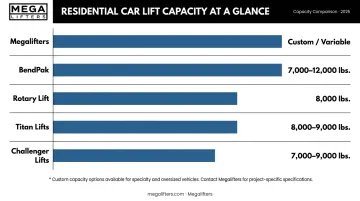
BendPak is a California-based manufacturer with one of the widest four-post storage lift lineups in the U.S. market. Their residential and enthusiast-grade parking lifts range from the HD-7P narrow-rise to the HD-9XW extra-tall/wide and the PL-12000DP tandem platform system, covering a capacity range of 7,000–12,000 lbs.
Published prices run from $6,095 for the HD-9 up to $25,495 for the PL-12000DP. Their 5-2-1 warranty covers five years on the structure, two years on hydraulics, and one year on operating components. Select models including the HD-7P and HD-9 carry ALI certification, though certification is model-specific — verify each unit individually.
| Specification | Detail |
|---|---|
| Lift Capacity Range | 7,000–12,000 lbs across storage lift models |
| Price Range | ~$6,095–$25,495 (published manufacturer pricing) |
| Customization | Standard and extended-length/width variants; no documented color customization |
Rotary Lift
Rotary Solutions operates one of the most established lift networks in North America, serving both professional shops and residential enthusiasts through its Direct Lift and Forward Lift brands. Their residential-focused parking lifts — the Direct Lift Pro Park 8S and the Forward Lift EFP8 — are rated at 8,000 lbs each and target auto enthusiasts directly.
Pricing is not published; Rotary uses a dealer and quote channel. Installation is available through Rotary Authorized Installers across the U.S. The Pro Park 8S carries 2025 ALI certification. Their broader catalog and service network also serves professional shops and dealerships, making them a viable choice across both market segments.
| Specification | Detail |
|---|---|
| Lift Capacity Range | 8,000 lbs (residential storage models) |
| Price Range | Quote-based through authorized dealer network |
| Best Use Case | Auto enthusiasts and professional/dealership environments |
Titan Lifts
Titan Lifts positions itself as the accessible, value-oriented option for residential buyers. Their four-post storage lineup includes the SDPL-8000, SDPL-8000XLT, and the Master Series SDPL-8KMS/9KMS, spanning 8,000–9,000 lbs of capacity. Pricing is transparent — the SDPL-8000 lists at $3,595, making it the most affordable entry point among the five providers listed here.
Each SDPL-8000 includes a caster kit, jack tray, three drip trays, and steel ramps. Caster kits allow compatible lifts to be repositioned when unloaded, offering some flexibility in garage layouts. No model-level ALI certification was found on reviewed product pages — verify independently before purchasing.
| Specification | Detail |
|---|---|
| Lift Capacity Range | 8,000–9,000 lbs |
| Price Range | ~$3,595–$4,615 (published manufacturer pricing) |
| Key Advantage | Lowest published price point; caster kit mobility available |
Challenger Lifts
Challenger Lifts offers a home storage four-post line — the CL4P7, CL4P9S, CL4P9X, and CL4P9W — covering standard, extended-length, and extended-width configurations at 7,000–9,000 lbs capacity. Their product page explicitly addresses both home garages and commercial vehicle storage, making them a reasonable option across both markets.
The CL4P series uses a single-point manual release that disengages all column locks simultaneously without requiring compressed air. Challenger's home storage line is described by the manufacturer as ALI certified, though this should be verified at the model level through the ALI directory. Pricing is quote-based through dealers.
| Specification | Detail |
|---|---|
| Lift Capacity Range | 7,000–9,000 lbs |
| Price Range | Quote-based through dealer network |
| Best For | Residential home storage and light commercial use |
Key Features to Look for in a Double-Decker Car Storage System
Ceiling Height and Structural Clearance
Most non-retractable four-post systems require at least 10 ft of clear ceiling height for standard passenger vehicles. Trucks and SUVs push that requirement higher. The calculation isn't simple — it depends on the vehicle's roof height, the lift's collapsed platform height, and any overhead obstructions.
If a ceiling-mounted garage door opener eats into that clearance, a wall-mounted unit solves the problem cleanly.
Floor Load Capacity
Stacking two vehicles concentrates serious weight on a small floor area. BendPak requires a minimum of 4 inches at 3,000 PSI for their four-post models; Rotary's general guidance sets 5 inches at 3,000 PSI as the residential baseline. Requirements are model-specific — get the manufacturer's slab spec for the exact unit you're buying, and have your existing slab assessed before purchasing.
Weight Capacity and Vehicle Fit
Lift capacity should exceed the combined weight of the heaviest vehicles you plan to store. Standard residential lifts in this guide span 7,000–12,000 lbs total capacity.
Low-profile exotics, wide-body builds, and heavy full-size trucks often fall outside the dimensional envelope of off-the-shelf platforms. Providers like Megalifters — who build platforms to any size and weight specification — can accommodate what catalog products simply aren't built to handle.
Access Independence
How often you need each vehicle determines which system type makes sense:
- Fixed four-post systems — lower car must be moved to retrieve the upper car. Fine for seasonal storage or a car you rarely touch.
- Pit-based retractable systems — both vehicles independently accessible. Better for daily drivers you need to reach without disturbing the other.
Match the system type to how frequently you actually need each vehicle. Once that's settled, the next consideration is whether the vehicles you're storing need power while they sit.
EV Charging Compatibility
About 80% of EV charging occurs at home, according to the U.S. Department of Energy — and as EV adoption climbs, stacked-storage buyers increasingly need to charge vehicles in place. Retrofitting EV charging into an existing lift after installation is costly and often structurally impractical. Megalifters builds their EV+ Charging Integration directly into the platform at the point of manufacture — available across all their models from the start.
How to Choose the Right Double-Decker System
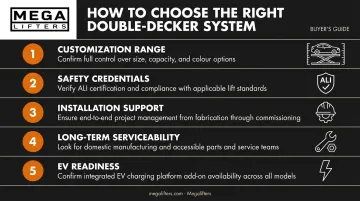
Not all double-decker systems are built the same — and the wrong choice is expensive to undo. Run any system you're considering through these five filters:
- Customization range: Can it accommodate your specific vehicles, bay dimensions, and ceiling height? Generic lifts fail collectors with unusual spaces or wide-body vehicles.
- Safety credentials: ALI certification is model-specific — verify against the ALI directory of certified lifts for the exact unit, not just the brand.
- Installation and design support: Some providers ship a product and walk away. For non-standard installs — unusual ceiling heights, tight bays, wide-body vehicles — full project management from design through installation matters far more than price alone.
- Long-term serviceability: The right system should serve a collection for decades. Parts availability and a responsive service network matter — don't let upfront price be the only deciding factor.
- EV readiness: Even if your current vehicles are all combustion-powered, plan ahead. The next 10–15 years will bring significant shifts in what collectors drive and store.
Conclusion
Double-decker car storage is no longer a niche solution. For collectors, multi-car households, dealerships, and urban parking operators, vertical stacking is often the most practical path to meaningful capacity gains — without structural additions or property expansion.
Choosing the right system means matching ceiling height, floor load capacity, and weight ratings to the actual vehicles and space involved. A standard four-post lift may work perfectly for a seasonal second car. But for collectors with wide-body exotics, EVs, or garages that don't conform to standard dimensions, an off-the-shelf lift can fail on weight rating, platform width, or ceiling clearance — exactly the variables a purpose-built system is designed around.
If you're working through those decisions for a specific garage and collection, Christopher Burcham and the Megalifters team handle every project from architectural design through installation. Reach them at (313) 702-1023 or info@megalifters.com to start a consultation.
Frequently Asked Questions
Frequently Asked Questions
What is the price of a double garage?
Building a two-car garage structure typically costs between $15,000 and $40,000 depending on size, materials, and location. A car stacking lift system runs separately, from roughly $3,500 for an entry-level four-post unit up to $25,000+ for custom or tandem platform configurations.
What is a double deep garage called?
A double deep garage is commonly called a tandem garage — one elongated bay where cars park front-to-back at ground level. This is distinct from a double-decker or stacked garage, where cars are stored vertically on a lift platform rather than lined up horizontally.
Is a 24x24 garage big enough for 2 cars?
A 24x24 garage provides 576 sq ft and is generally considered adequate for two standard vehicles side by side. Adding a four-post stacking lift in one stall can allow three or even four vehicles to be stored within the same footprint, depending on ceiling clearance.
What ceiling height is needed for a double-decker car lift?
Most residential four-post storage lifts require a minimum of approximately 10 ft of clear ceiling height for standard passenger vehicles. Taller vehicles like trucks or SUVs require additional clearance, and exact requirements vary by lift model and vehicle combination — confirm specs with your installer before purchasing.
Can I add a car lift to my existing garage?
Most existing garages can be retrofitted with a four-post lift if the ceiling height, floor slab thickness (typically 4–5 inches at 3,000 PSI), and electrical supply meet the system's requirements. A specialist installer should assess the space before you purchase any system.
What is the weight capacity of a typical car storage lift?
Most residential four-post parking lifts are rated between 7,000 and 12,000 lbs total capacity. Collectors storing heavy classics, performance vehicles, or EVs should verify the lift's rated capacity against actual vehicle weights, including a reasonable safety margin.