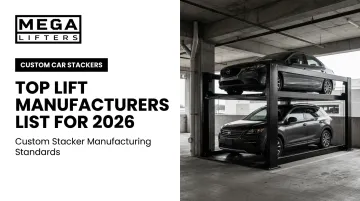
Picking the wrong lift manufacturer, though, can mean safety headaches, unplanned maintenance costs, or a system that simply can't grow with your needs. The right manufacturer maximizes storage capacity while keeping vehicles (and the people around them) safe for decades.
The U.S. automated parking-system market hit $434.5 million in 2023 and is projected to grow at an 18.4% CAGR through 2030, according to Grand View Research. Here's who's leading that shift in 2026.
TL;DR
- The market spans heavy-duty service lift brands and dedicated parking/stacker specialists
- Prioritize certifications, customization range, EV-readiness, and long-term support over sticker price
- Six leading manufacturers made this list: BendPak, Rotary Lift, Mohawk Lifts, WOHR Parking Systems, Park Plus, and Megalifters
- Megalifters offers fully custom stacker design with EV charging built directly into the platform
Overview of Lift Manufacturing in the Automotive & Parking Industry
Not all "lifts" do the same job. Service lifts raise vehicles for repair and inspection. Parking lifts (stackers) exist purely to store vehicles vertically and multiply usable space. Confusing the two can lead buyers to the wrong product entirely.
The distinction matters because certification standards differ. Service lifts fall under the established ANSI/ALI ALCTV framework, while stationary storage stackers fall under a newer, still-developing ALI standard (VSPL). Buyers need to know which category their intended lift falls into before signing a contract.
That clarity matters more than ever, because demand for parking stackers specifically is accelerating fast:
- Urban land costs and shrinking dealership lots are pushing operators toward vertical solutions
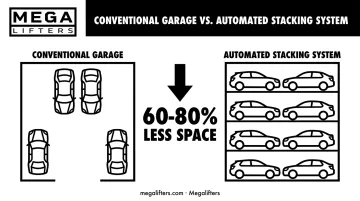
- Automated platforms can cut required parking footprint by 60-80% compared to conventional garages, according to ParkPlus
- Rising EV adoption is forcing manufacturers to rethink lift design around charging access, not just storage
The manufacturers below serve everyone from single-car residential garages to sprawling commercial lots and dealership rows.
Top Lift Manufacturers for 2026
Selection here comes down to four things: build quality, certification status, customization range, and a track record buyers can trust. Below is how six major players stack up.
BendPak
BendPak traces its roots to 1965 as Quality Machine & Associates, with the BendPak brand launching in 1979 out of Southern California. Today it produces one of the broadest automotive lift catalogs in North America, including parking-style stacker platforms.
Its differentiators include heavy-gauge steel construction and a wide distributor network across the U.S. and Canada. Certification, though, is model-specific: BendPak states plainly that not every lift meets ANSI/ALI ALCTV, so buyers should verify the exact model in ALI's directory rather than assume company-wide compliance.
| Attribute | Details |
|---|---|
| Specialty | Two/four-post lifts and parking lift systems for commercial and residential garages |
| Capacity Range | Roughly 6,000-9,000 lb across documented parking/storage models |
| Certifications | ALI Gold Label available on select models; always confirm the specific model number |
Rotary Lift (Vehicle Service Group)
Rotary Lift's history goes back to 1925, when Peter Lunati patented the first hydraulic automotive lift. The company joined Dover Corporation in 1955, and Vehicle Service Group was formed in 2009 to combine Rotary Lift with Chief Automotive Technologies.
The brand's century of patents and its global service footprint, spanning Indiana, Italy, and China, give it strong standing in commercial and high-volume facilities. Some parking-capable products in the Rotary Solutions catalog actually ship under sister brands like Direct Lift or Forward Lift, so it's worth double-checking labeling before purchase.
| Attribute | Details |
|---|---|
| Specialty | Heavy-duty vehicle lifts with parking-lift configurations for high-volume facilities |
| Capacity Range | 8,000-9,000 lb across four-post parking-capable models |
| Notable Feature | Century-old patent lineage plus a broad international dealer and service network |
Mohawk Lifts
Mohawk has manufactured lifts in Amsterdam, New York, since 1981, and it markets its equipment as designed, welded, and built entirely in the United States. That domestic manufacturing focus is central to its brand identity.
Durability is Mohawk's calling card. Its two-post storage configurations use wheel-adapter kits to handle heavier loads, and the company backs most of its two-post line with an unusually long warranty, a strong signal of confidence in build quality.
| Attribute | Details |
|---|---|
| Specialty | Two-post, four-post, and parking lift systems built for longevity |
| Capacity Range | 10,000-18,000 lb for two-post car storage configurations |
| Warranty | 25-year structural, 10-year mechanical, limited lifetime cylinder warranty (TL-7 model excluded) |
WOHR Parking Systems
WOHR Autoparksysteme is headquartered in Friolzheim, Germany, and has spent decades specializing in automated and puzzle-style multi-level parking. It's less of a hardware supplier and more of a systems engineer for dense urban sites.
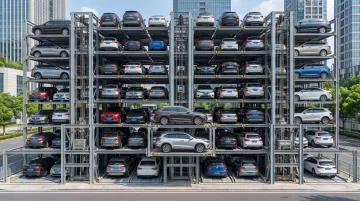
Its Combilift puzzle systems stack vehicles across three levels and four rows deep, while the Multiparker family scales dramatically. Depending on configuration, WOHR systems can house anywhere from 10 spaces to over 1,000, making it a go-to for municipal and large commercial structures worldwide, including a recent installation in San Diego.
| Attribute | Details |
|---|---|
| Specialty | Automated multi-level and puzzle-style parking systems for urban density challenges |
| Capacity Range | 10 to 100+ spaces per Multiparker install; broader product family can exceed 1,000 spaces |
| Best Suited For | Large commercial and municipal parking structures requiring high-density automation |
Park Plus Inc.
Founded in Queens, New York, in 1969, Park Plus (ParkPlus) has completed over 1,500 U.S. projects and now operates out of East Rutherford, New Jersey. The company has built its reputation squarely around robotic and software-driven parking rather than traditional mechanical lifts.
Its AGV robots and Rack & Rail shuttle systems both handle vehicles up to 6,000 lb, retrieving cars in roughly 2-4 minutes through a mobile app, kiosk, or key fob. Documented installations range from 30-space projects to a 411-space system in Miami that includes 80 EV-charging stalls.
| Attribute | Details |
|---|---|
| Specialty | Automated/robotic parking systems for commercial real estate and residential towers |
| Capacity Range | Up to 6,000 lb per vehicle; installations from roughly 30 to 400+ spaces |
| Technology | Software-driven vehicle retrieval via AGV robots, Rack & Rail shuttles, and app-based access |
Megalifters
Megalifters started with a problem, not a business plan. Founder Christopher Burcham, an architectural designer, was designing a car dealership and couldn't find any existing product that could maximize vertical stacking on the lot. So he engineered his own. That project became the foundation of a company now focused entirely on custom automobile stacking.
What sets Megalifters apart is the word "custom" actually meaning something. Every unit ships in any color, size, and weight capacity the project calls for, scaling from a single residential bay to installations covering thousands of vehicles on a city block.
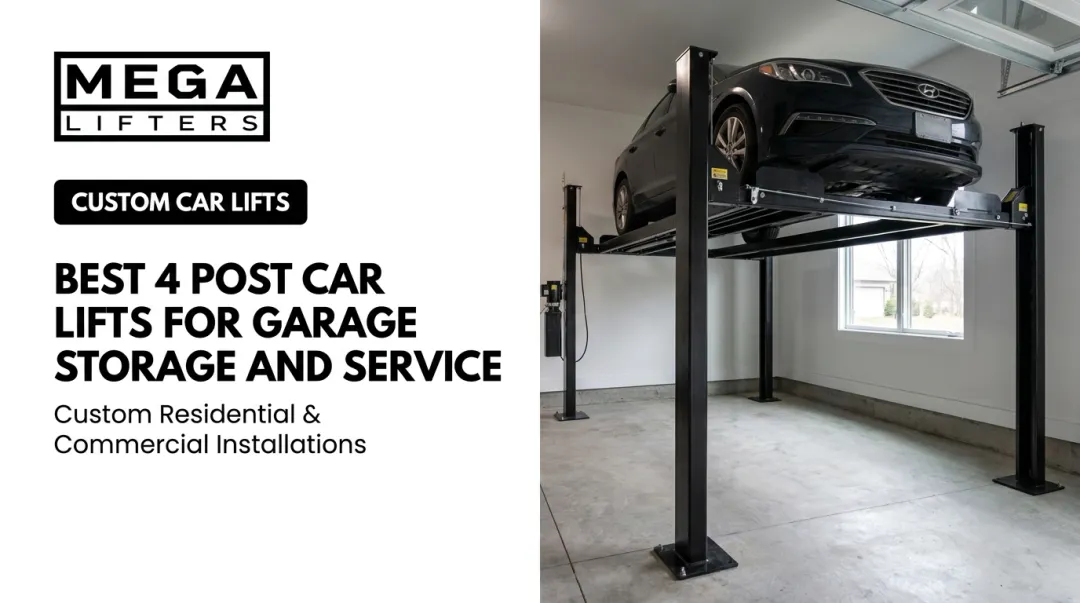
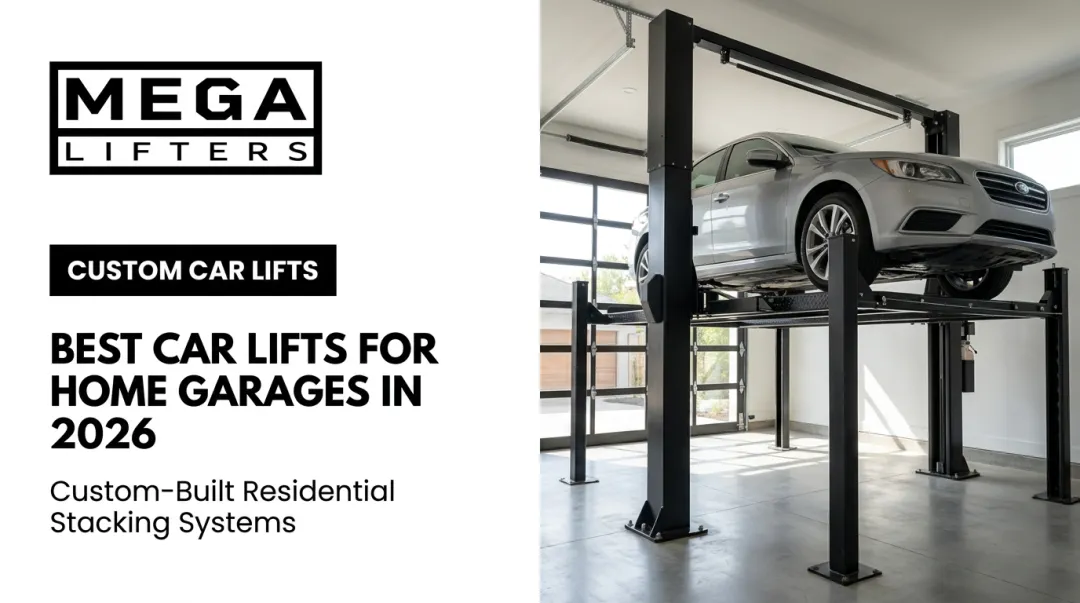
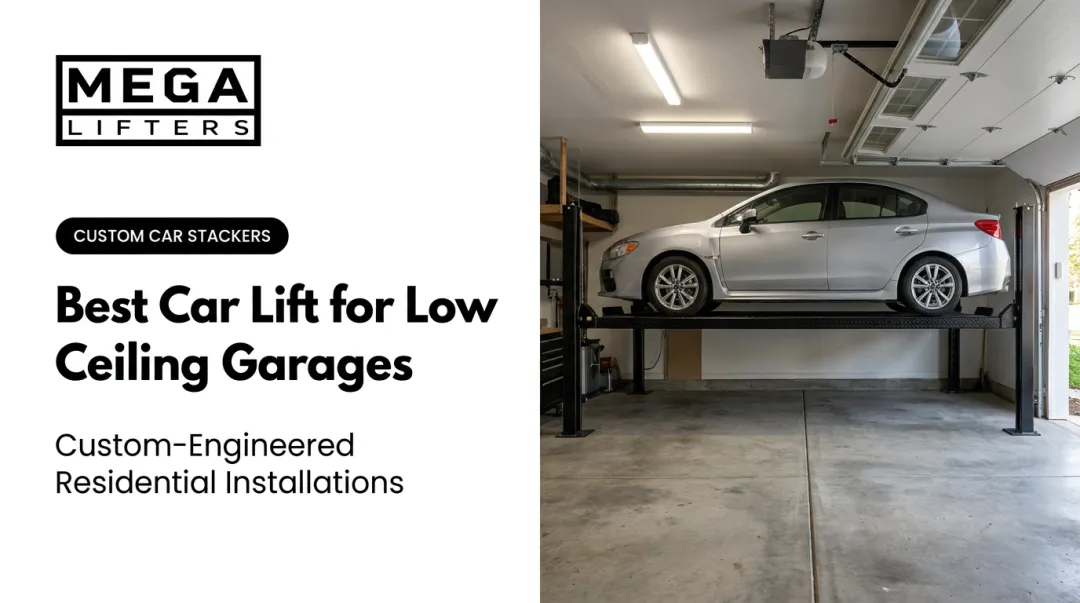
The lineup runs from compact 2-Post and 4-Post single-car lifts through Double, Triple, and Quad configurations (the Quad requiring 25+ feet of ceiling clearance). Megalifters is also the first stacker manufacturer to build EV charging directly into the lift platform, with Basic, Intermediate, and Advanced tiers covering everything from plug-and-play home charging to dual-unit commercial supercharging.
| Attribute | Details |
|---|---|
| Specialty | Custom-designed automobile stackers for dealerships, residential garages, and commercial parking |
| Capacity Range | Scalable from single-stall residential installs to large-scale commercial and urban lots |
| Unique Feature | EV charging integration built into the platform, plus tailored pricing scoped to each project's site and capacity needs |
How We Chose the Best Lift Manufacturers
Most buyers make one mistake: they shop by sticker price alone. That approach ignores certification gaps, maintenance costs down the road, and whether the system can actually fit the site once installation begins.
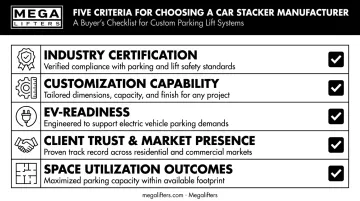
We weighed manufacturers against factors that affect total cost of ownership:
- Industry certification — ALI Gold Label certification applies per model, not company-wide, so we verified each one individually via ALI's certification FAQ
- Customization capability — Can the manufacturer actually adapt to unusual ceiling heights, odd bay widths, or unique color/branding requests?
- EV-readiness — Is charging infrastructure built into the platform, or bolted on as an afterthought?
- Client trust and market presence — Track record, project portfolio, and transparency about pricing and process
- Space utilization outcomes — Does the system deliver on the density gains it promises?
Conclusion
Choosing the right lift manufacturer means matching capacity range and EV-readiness to your space, with customization built around your five-year plan, not chasing the biggest name in the market.
Before signing anything, weigh scalability and total lifetime cost, not just the invoice total. Flexibility matters too, especially if your parking needs will grow.
If you're planning a dealership expansion, a residential garage upgrade, or a large-scale urban parking project, reach out to Megalifters for a custom automobile stacking quote. We'll build it around your exact space and EV-charging needs.
Frequently Asked Questions
What is the difference between a car service lift and a parking lift/stacker?
Service lifts raise vehicles for repair and inspection, built to the ANSI/ALI ALCTV standard. Parking lifts (stackers) exist purely to store vehicles and maximize density, and fall under a newer ALI framework specific to storage equipment.
How much does a parking lift or car stacker typically cost?
Pricing varies widely based on capacity, customization, and installation complexity, with automated systems often running $15,000-$40,000 per space installed. Because every site and configuration differs, requesting a tailored quote is the only way to get an accurate number.
What certifications should I look for in a lift manufacturer?
Look for the ALI Gold Label on the specific model you're buying, not just company-wide claims. ALI certification is product-specific, so always verify the exact model in ALI's certified lift directory.
Can car lifts or parking stackers be integrated with EV charging?
Yes. Select manufacturers now build EV charging directly into stacker platforms rather than adding it separately. Megalifters, for example, offers Basic, Intermediate, and Advanced charging tiers built into the lift itself, letting owners charge while they stack.
How long do parking lifts and car stackers typically last?
Well-maintained systems typically last 15-25 years, though lifespan depends heavily on indoor versus outdoor exposure, duty cycle, and how consistently the lift is inspected and serviced. Annual inspection by a qualified lift inspector helps catch wear before it becomes a safety issue.
Are parking lifts safe for residential garage use?
Yes, when the system is certified and properly installed. The 2024 International Residential Code requires covered residential lifts to meet the ANSI/ALI ALCTV standard, detailed on ALI's code enforcement page. Certified stackers are increasingly common in home garages.