Here's the problem: picking the wrong lift type, size, or footprint is an expensive mistake. Get it wrong and you end up with an unsafe setup, a lift that won't clear your ceiling, or a system that tanks your garage's resale appeal.
This guide breaks down every lift type available in 2026, top picks by budget and use case, the garage specs you need to check before buying, and a space-saving alternative worth knowing about if you're trying to store more than one car.
Key Takeaways
- 2-post lifts suit repair work; 4-post and stacking lifts suit vehicle storage
- Ceiling height is the biggest constraint — full-rise lifts need 10-12+ ft, portables fit 8-ft garages
- Total installed cost varies by lift type, electrical work, and installation labor
- Custom stacking lifts beat standard 4-post units on space efficiency for multi-car garages
- ALI certification and mechanical safety locks are non-negotiable, regardless of price point
Types of Car Lifts for Home Garages: Which One Fits Your Needs?
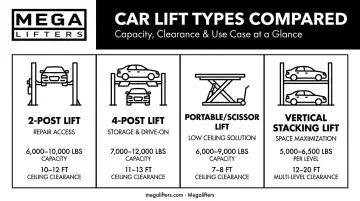
The "right" lift comes down to one question: is your priority repair work, storage, or squeezing more cars into less floor space? That answer determines everything else: capacity, ceiling requirements, and budget.
2-Post Lifts
These lifts grab the vehicle's frame with swing arms, leaving the wheels hanging free. That's the whole appeal: full undercar access at standing height, which makes brake jobs, oil changes, and suspension work dramatically easier than crawling on a creeper.
They're the default pick for home mechanics who do regular maintenance. BendPak's lighter-duty 2-post models run 9,000-10,000 lb, with the GP-7 series specifically built for shorter ceilings.
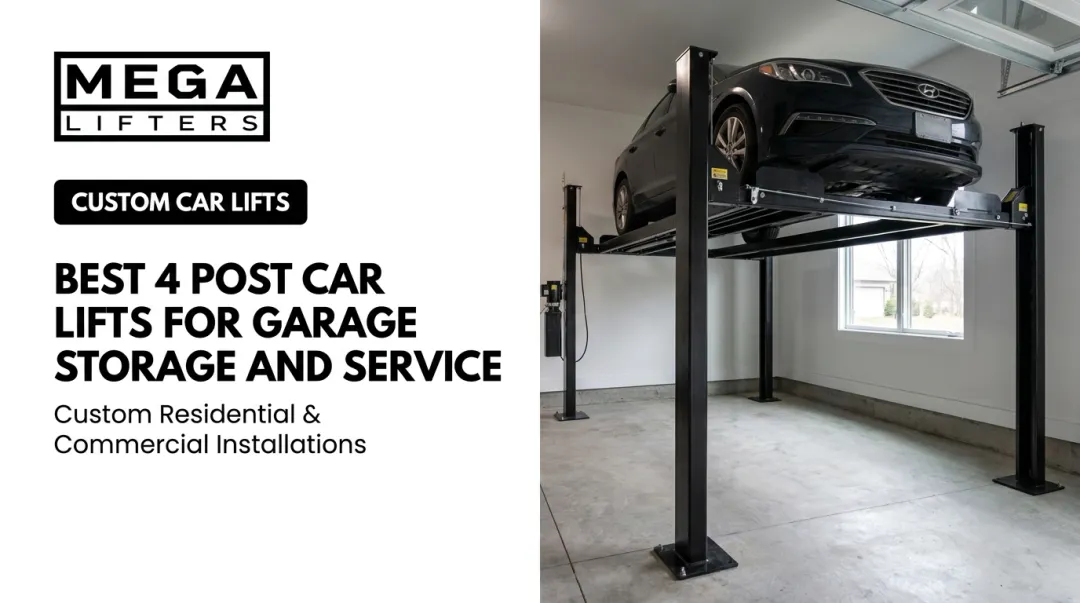
4-Post Lifts
Vehicles drive straight onto the runways: no lifting points to locate, no arm positioning. That drive-on simplicity is why 4-post lifts double as second-vehicle parking and, with an added rolling bridge jack, occasional service capability.
- Runways support the full vehicle weight without wheel contact
- A bridge jack lifts wheels off the runway for tire or brake work
- Storage-first buyers benefit more from this design than dedicated mechanics
Portable & Scissor Lifts
Low ceiling? Renting your space? Don't want a permanent installation? Portable and scissor lifts solve all three. They plug into a standard outlet, roll under the car, and don't require anchoring into your slab.
Published rise heights range from 23 inches to just over 4 feet, depending on the model — enough to get underneath a vehicle without needing a 10-12 foot ceiling.
Vertical Stacking & Parking Lifts
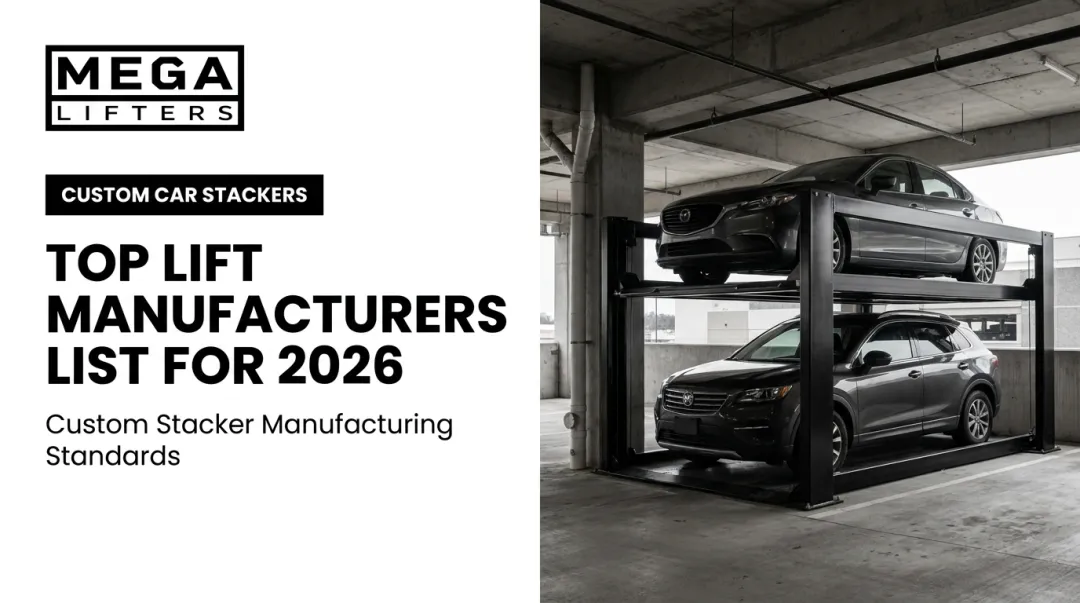
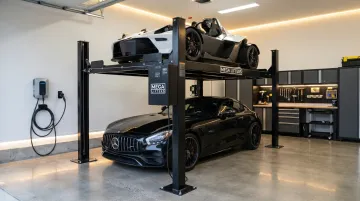
This is the category most home-garage buying guides skip entirely, and it shouldn't be. Stacking lifts store two vehicles in the footprint of one bay by elevating one car above the other (think of it as a private 4-post system built specifically for maximizing vertical airspace rather than service access).
Megalifters specializes in this exact niche: fully custom stacking solutions for residential garages, including EV charging integration built directly into the platform.
For readers whose garage math doesn't work with a standard 4-post unit (say, three vehicles and only two bays), this is worth a serious look before settling for less storage than you actually need.
Best Car Lifts for Home Garages in 2026
Every pick below meets four criteria: ALI safety certification, capacity that comfortably exceeds your vehicle's weight (not just matches it), solid warranty and manufacturer support, and a fair price-to-quality ratio.
Best 2-Post Lifts
The Atlas Platinum PVL10 is the strongest all-around 2-post pick for home garages. It's ALI certified, supports symmetric or asymmetric arm configuration, and reaches 72.5 inches of lift height without adapters.
| Model | Capacity | Configuration | Price |
|---|---|---|---|
| Atlas Platinum PVL10 | 10,000 lb | Symmetric/asymmetric, 220V | ~$5,449 |
For a lower ceiling and a smaller budget, BendPak's GP-7 series is the better fit, offering ALI certification, 9-, 10-, and 13-foot ceiling versions, and a 7,000 lb capacity that covers the vast majority of home garage vehicles at a more accessible price point than full-rise units.
Best 4-Post Lifts
If storage-oriented drive-on convenience is the goal, the BendPak HD-9ST delivers a 9,000 lb capacity in a narrow-width footprint built for residential bays.
| Model | Capacity | Width | Price |
|---|---|---|---|
| BendPak HD-9ST | 9,000 lb | 100.25 in | Starting at $5,995 |
| BendPak HDS-14 | 14,000 lb | 130 in | $8,120-$8,595 |
For trucks and SUVs that exceed standard capacity, step up to the BendPak HDS-14. Its 14,000 lb rating and 70-inch rise handle heavier vehicles that a standard 9,000 lb unit can't safely support.
Best Portable & Scissor Lifts
Working in an 8-foot garage? The QuickJack 8000TL is built for exactly that. It's 8,000 lb rated, runs on standard 110V power, and delivers a 24.25-inch lift, enough clearance for most maintenance work without needing full standing height.
| Model | Capacity | Power | Rise | Price |
|---|---|---|---|---|
| QuickJack 8000TL | 8,000 lb | 110V | 24.25 in | ~$2,100 |
| BendPak LR-10000 | 10,000 lb | 230V | 23 in | Starting at $5,495 |
Trucks and heavier SUVs that need more capacity are better matched to the BendPak LR-10000, marketed specifically for that heavier vehicle class.
Best for Maximizing Garage Space: Custom Stacking Lifts
None of the above solve one specific problem: needing to store more vehicles than your garage has bays for. That's where Megalifters' custom stacking systems come in.
Their lineup covers everything from single-vehicle 2-post and 4-post stackers to Double, Triple, and Quad Car Lifts that store up to four vehicles in one footprint. Every unit is built to order:
- Any color, size, and weight capacity, with no fixed catalog specs
- EV charging integration across Basic, Intermediate, and Advanced tiers, built into the platform itself
- Double Wide configurations for side-by-side plus stacked storage without needing two separate lift systems
The Triple Car Lift needs 20+ feet of ceiling clearance; the Quad needs 25+ feet. If your garage can't clear that, the single-vehicle 2-post or 4-post stackers are the more realistic starting point.
Garage Requirements & Buying Factors to Check First
Ceiling Height
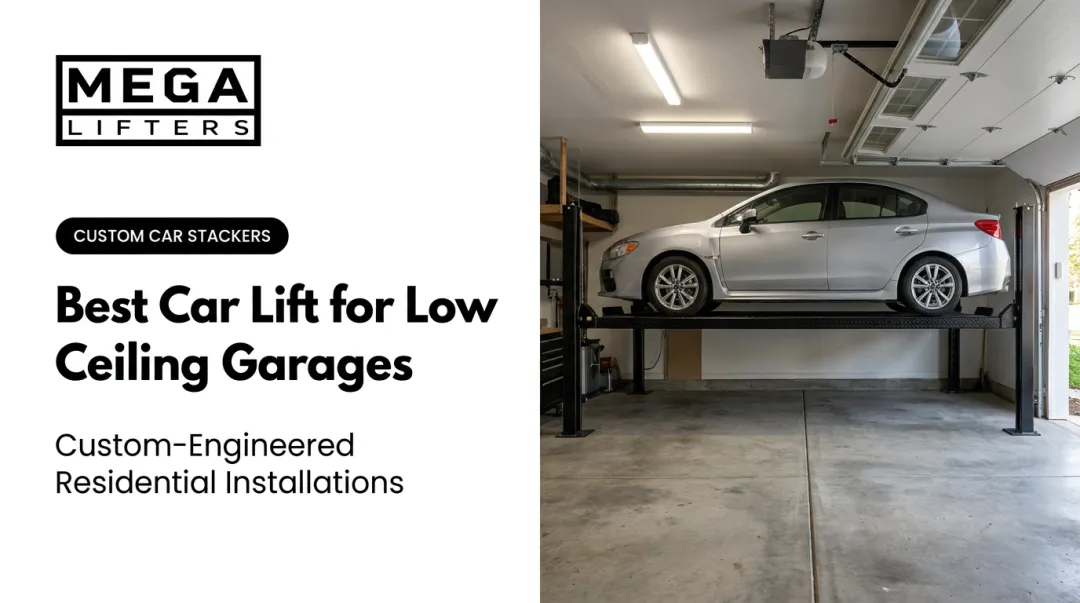
Measure to your lowest obstruction (a duct, a light fixture, a garage door track), not the ceiling surface itself. That number, not the ceiling height on paper, determines what you can actually install.
- 8 feet: Portable/low-rise lifts only
- 9-10 feet: Low-ceiling 2-post variants (GP-7 series) and most 4-post units
- 12+ feet: Full-rise 2-post lifts with standard clearance
Concrete Slab & Electrical
Column lifts anchor into your slab, so thickness and PSI matter. Requirements vary by model: Atlas specifies 4 inches at 3,000 PSI for the PVL10, while Rotary's general guidance calls for 5 inches at 3,000 PSI. Always confirm against the specific manual, not a general rule of thumb.
Power requirements are equally model-specific:
- 110V/115V: Most portables and mid-rise scissor lifts
- 220V/230V: Most 2-post and 4-post column lifts
Don't assume voltage by lift category; check the data plate.
Floor Space & Budget
Beyond ceiling height, you need clearance for the lift's footprint, door swing, and space to walk around a raised vehicle. Budget realistically:
- Budget tier: Portable lifts, roughly $2,000-$3,000
- Mid-range: Standard 2-post or 4-post units, roughly $5,000-$8,500
- Premium: Heavy-duty 4-post or fully custom stacking systems, quote-based
Installation, Cost, and Maintenance Overview
2-post lifts almost always require professional installation. Manufacturer manuals (including BendPak's) specify that a licensed, certified electrician must handle the wiring, and anchoring into the slab needs precise calibration. Portables and some 4-post units are more DIY-feasible since they skip permanent anchoring. Megalifters handles this professional installation on every custom 2-post and 4-post project we build.
On the payback math: shop labor runs $100-150/hour, and doing even four to six jobs a year yourself means a mid-range lift often pays for itself within two to four years. That timeline shrinks further if you're maintaining multiple vehicles.
Maintenance is non-negotiable. ALI standards require a qualified inspection at least annually, regardless of lift brand or age. Beyond that:
- Check safety locks daily before use
- Monitor hydraulic fluid level and quality per the manufacturer schedule
- Budget for periodic cable, cylinder, or seal replacement over the lift's lifespan
Conclusion
The best car lift matches what you're actually doing in your garage, not the specs sheet or review count. Match your priority to the right system:
- Repair work → 2-post lift
- Storage and drive-on convenience → 4-post lift
- Tight ceilings → portable lift
- Running out of parking spaces → stacking system
Before you buy, think past today's garage. Will you add a vehicle in five years? Does this setup help or hurt resale? Total cost matters more than sticker price once you factor in electrical work, concrete prep, and installation.
If your real problem is fitting more vehicles into a garage that's already full, or you want EV-charging-ready parking built into the platform, Megalifters can help. The company designs and installs fully custom stacking solutions for residential garages nationwide, from single-stall setups to multi-car systems built around your exact space.
Frequently Asked Questions
Is a 2-post or 4-post car lift better?
2-post lifts win for repair and maintenance access since they leave the wheels free for undercar work. 4-post lifts win for storage and drive-on convenience, especially when parking a second vehicle is the main goal.
What is the best car lift for a home garage?
It depends on your ceiling height, budget, and primary use case. The Atlas PVL10 leads for repair work, the BendPak HD-9ST for storage, and Megalifters' custom stackers for multi-car space maximization.
What is the safest type of car lift?
ALI-certified lifts with mechanical safety locks are the safest choice across every category. Look for the ALI Gold Certification Label and verify the specific model in the ALI's certified lift directory before buying.
How much does it cost to install a car lift in a home garage?
Portable lifts start around $2,000-$3,000 equipment-only. Full 2-post or 4-post installs typically run $5,500-$8,500 for the unit, plus separate costs for electrical work and any needed concrete prep.
What ceiling height do I need for a car lift?
Portables work in 8-foot garages, mid-rise scissor lifts need slightly more headroom, and full-rise 2-post or 4-post lifts generally require 10-12+ feet depending on the specific model.
Can a stacking or parking lift replace a traditional 2-post or 4-post lift?
Stacking lifts are built for storage and space maximization, not wheel-off service access. They work best alongside a service lift rather than replacing one outright, particularly if you plan to do your own maintenance.