That assumption is wrong more often than not.
Several lift categories are engineered specifically for short garages. The real risk isn't a low ceiling. It's buying the wrong lift for one. Get the numbers wrong and you're looking at a crossbar that clips your ceiling joists, a concrete pad poured for a lift that never fits through the door, or an expensive return shipment.
This guide breaks down why standard lifts fail in tight garages, which lift styles actually work in 7-10 ft spaces, how to measure correctly before you buy, and what to do if you need more than basic service access.
Key Takeaways
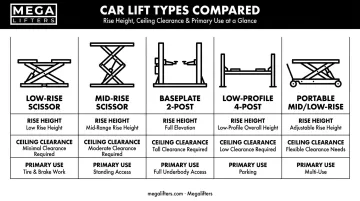
- Low-rise scissor lifts (20-24 in rise) fit almost any garage, even under 8 ft ceilings.
- Mid-rise scissor lifts (41-48 in rise) give full standing access in 9-10 ft garages.
- Baseplate 2-post lifts skip the overhead crossbar but still need 9.5+ ft of ceiling.
- Low-profile 4-post lifts (6 ft 9 in to 8 ft 1 in tall) double parking in short garages.
- Subtract your vehicle's height from ceiling height before buying, not after.
Why Ceiling Height Determines Your Car Lift Options
Every car lift purchase comes down to one equation: ceiling height needed = lift's max rise + vehicle height + a few inches of working clearance. Skip this math and you'll find out the hard way, usually mid-install.
Standard two-post lifts are the biggest offenders. According to Rotary's installation guidance, a typical two-post lift calls for around 12 ft of ceiling height and a 12 x 24 ft operating footprint.
That single number explains why most residential garages, which rarely clear 9-10 ft, can't run a traditional overhead lift without a garage addition.
The Reverse Formula You Should Actually Use
Instead of asking "what's the tallest lift I can fit," flip the question:
Max safe rise = ceiling height − vehicle height
Worked example: a 96-in (8 ft) ceiling minus a 57-in sedan roof leaves 39 inches of usable rise. That number, not the lift's advertised maximum, is what determines whether a model will actually work in your bay.
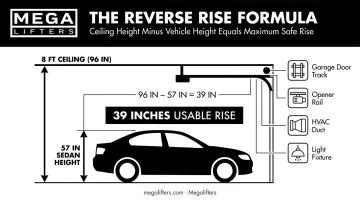
A few things shrink that number further than most buyers expect:
- Garage door tracks hanging below the stated ceiling height
- Garage door openers and their rail assemblies
- HVAC ducts or exposed joists
- Light fixtures or ceiling fans
Measure at the lowest point in the bay, not the peak. That's the number that matters.
With the math settled, here's how the major lift categories stack up against real-world garage heights.
Best Car Lifts for Low Ceiling Garages
These picks are grouped by lift style and chosen for rise height, footprint, capacity, and how well each one actually performs in a short garage.
Low-Rise Scissor Lifts (Best for Ceilings Under 8 Ft)
Low-rise scissor lifts drive on at roughly 4 inches and rise only 20-24 inches, making them the shortest lift category on the market. BendPak's LR-60, for example, sits at 3.5 in lowered and lifts to 23 in without blocks, running on standard 110V power.
The trade-off: you're working from a creeper or a rolling stool, not standing upright underneath the car. That makes these lifts a fit for:
| Rise Height | Best For | Power/Install |
|---|---|---|
| ~20-24 in, multiple lock positions | Tires, brakes, oil changes, detailing | 110V, portable with wheel kits available, no permanent mounting needed |
If your garage clears under 8 ft, this is likely your only real option for raised access without cutting into the ceiling.
Mid-Rise Scissor Lifts (Best Balance for 9-10 Ft Garages)
This is where most low-ceiling buyers land. Mid-rise scissor lifts rise roughly 41-48 in, giving you comfortable wheels-off access for brake, exhaust, and suspension jobs without any overhead structure at all.
BendPak's MD-6XP lowers to just 4.75 in, reaches a 47-in lifting height (48 in with standard blocks), and runs on 115/220V. A 9-10 ft ceiling lets most sedans and SUVs use nearly the full range of that travel.
| Rise Height | Best For | Power/Install |
|---|---|---|
| ~41-48 in depending on model | Brake, tire, exhaust, suspension work | 110V or 220V; fixed or portable versions available |
Baseplate (Floor-Plate) 2-Post Lifts (No Overhead Crossbar)
Running the hydraulics through a floor-mounted baseplate instead of an overhead crossbar shaves real height off the equation. It's the closest thing to a "true" two-post lift that low-ceiling buyers can install.
The catch: you still need meaningful clearance. Once the vehicle is fully raised, it's hanging overhead just like it would on a standard model.
| Overall Height Needed | Best For | Capacity |
|---|---|---|
| Roughly 9.5 ft and up | Full underbody access, no overhead obstruction | Commonly 9,000 lb+, fits most cars, SUVs, light trucks |
This category solves the crossbar problem, but it won't help a garage under 9 ft.
Low-Profile 4-Post Storage Lifts (Best for Doubling Parking Space)
Not every low-ceiling buyer needs raised repair access. Some just need to fit two cars where there's only room for one. Certified low-profile 4-post lifts are built for exactly that.
Direct Lift's Pro Park 8S carries an 8,000-lb capacity on columns just 6 ft 9.5 in tall, running on standard 115V power. That's short enough to work in genuinely tight garages, though it's built for parking, not raised maintenance work.
| Overall Height | Capacity | Best For |
|---|---|---|
| Roughly 6 ft 9 in to 8 ft 1 in | Typically 8,000-9,000 lb | Doubling parking in a short garage |
One caution here: not every four-post model in this weight class is short. Some extended versions run closer to 99 in tall, so check the exact model spec, not just the product family name.
When no off-the-shelf model matches your exact ceiling height, capacity, or footprint, custom manufacturers like Megalifters build 4-post stacking lifts sized to the space rather than a standard product line.
Portable Mid-Rise/Low-Rise Lifts (Best for Renters & Multi-Use Bays)
If your bay doubles as a workshop, storage room, or gym, a wheel-kit lift that stores flat solves a different problem: floor space, not just ceiling space.
QuickJack's 6000TL, for instance, collapses to just 3 in and reaches 24 in of lift, sold in a 110V configuration. Models like this roll into a corner when not in use.
| Stored Height | Best For | Power/Air |
|---|---|---|
| As low as 3-5 in when folded | Renters, multi-use bays, occasional users | 110V standard; some models require compressed shop air for lock release |
How to Choose the Right Low Ceiling Car Lift
Once you know which category fits your rise needs, run through this checklist before ordering:
- Measure the true low point. Check door tracks, openers, light fixtures, and ductwork, not just the ceiling peak.
- Calculate usable rise. Subtract your tallest vehicle's roof height from your ceiling height, then compare that number to the lift's stated max rise.
- Confirm your power supply. Some lifts run on 110V, others need 220V. Check your garage's electrical panel before ordering.
- Verify slab thickness. Fixed lifts need adequate concrete depth, and generic slab guidance rarely covers every site. Megalifters designs each lift to your slab's actual specs, so custom installs skip this guesswork entirely.
- Decide your priority. Maintenance access points you toward scissor or baseplate 2-post lifts. Parking capacity points you toward 4-post storage lifts.
Getting steps 1 and 2 wrong is the single most common reason low-ceiling lift installs fail.
Need More Than a Service Lift? Custom Stacking Solutions for Tight Spaces
Some garages, dealerships, and lots need more than the occasional brake job. They need to double or triple parking capacity, and the ceiling height isn't going to change.
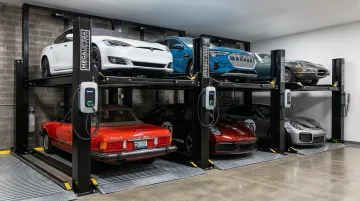
That's a different problem than the ones above, and it's the one Megalifters was built to solve. The company designs and installs fully custom automobile stacking systems, engineered around a client's exact ceiling height and floor footprint rather than sold off a fixed catalog spec sheet.
A few things set custom stacking apart from a standard service lift:
- Configurations for every space. Megalifters builds 2-post and 4-post single-car lifts, Double, Triple, and Quad stackers, and a Double Wide platform designed specifically for locations with floor width but limited ceiling height.
- Full customization. Every system is available in any color, size, and weight capacity, sized to the customer's bay, vehicle, and ceiling rather than a standard mold.
- EV charging built in. Megalifters offers Basic, Intermediate, and Advanced charging tiers that integrate directly into the stacking platform, a useful add-on for space-constrained residential and commercial parking alike.
- Scale from one stall to a city block. Projects range from a single residential garage to large-scale dealership and urban parking installations.
Founder Christopher Burcham started the company after running into this exact wall while designing a car dealership; no off-the-shelf stacker fit the space, so he engineered one. That problem-solving approach still shapes how each project gets scoped today.
If your garage or lot needs more than a catalog lift can offer, the next step is a scoping conversation built around your exact space and vehicles.
Conclusion
Choosing the right low-ceiling car lift comes down to matching rise height, footprint, and intended use—whether for repair work or long-term storage—against your actual measured clearance. Skip the guesswork and measure the lowest point in your bay before you shop.
Before finalizing anything, double-check your power supply and slab specs against the exact model you're considering, not a general product family.
For standard service lifts, the categories above are a solid starting point. If your garage or lot needs custom vertical stacking or EV-ready parking, Megalifters can design a system built around your exact space. Reach the team at (313) 702-1023 or info@megalifters.com.
Frequently Asked Questions
What is the minimum ceiling height for a car lift?
Low-rise scissor lifts need almost no overhead room and can work in garages under 8 ft. Full-rise two-post and four-post lifts commonly require around 11-12 ft due to the crossbar and lifted vehicle height.
What is the best 2-post lift for low ceilings?
Baseplate (floor-plate) 2-post lifts remove the overhead crossbar, making them the best 2-post option for tight garages. Most still require roughly 9.5 ft or more of clearance once the vehicle is fully raised.
What is a low rise surface mounted lift?
It's a lift that sits directly on the garage floor without pit installation, using a scissor mechanism to raise vehicles about 20-24 in. This design suits tire, brake, and fluid work rather than full underbody access.
Can a 4-post lift fit in an 8-foot garage?
Certain certified 4-post storage lifts have overall heights as low as 6 ft 9 in to 8 ft 1 in, making them workable in 8-ft garages. They're built for doubling parking capacity, not raised repair work.
What's the difference between a low-rise and mid-rise lift?
Low-rise lifts raise a vehicle about 20-24 in for creeper-level work. Mid-rise lifts raise it 41-48 in, giving standing or seated access. Neither requires overhead clearance the way a two-post lift does.
How much ceiling clearance does a mid-rise scissor lift need?
Plan for the lift's rise (41-48 in) plus your vehicle's height plus a few inches of working clearance. A 9-10 ft ceiling typically allows most of the lift's full travel on a sedan or SUV.